
Accurate dosing
anytime, anywhere
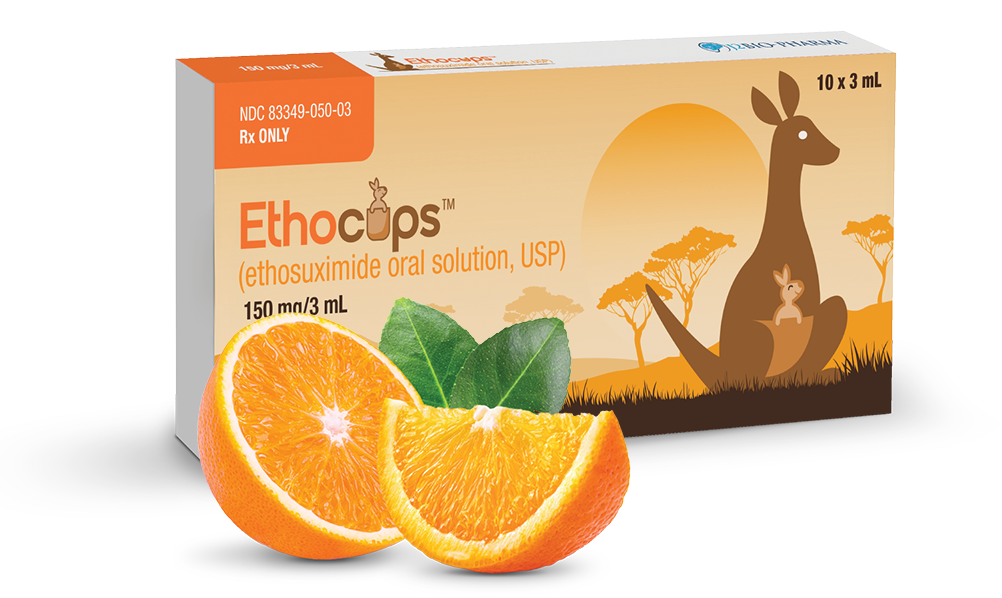
Introducing new ETHOCUPS, the first and only prefilled dosing cup formulation for the control of absence (petit mal) seizures1
Accurate dosing anytime, anywhere
Prescribe ETHOCUPS and leave challenges behind

Accuracy
No measuring required

Convenience
No cleanup or restorage for portable dosing

Adherence
Orange flavor to help improve adherence
Designed to simplify dosing, ETHOCUPS makes accurate dosing easier1
Pediatric medication dosing errors by caregivers remain prevalent, especially with liquid formulations.2
The prefilled cup formulation of NEW ETHOCUPS supports precise dosing of ethosuximide

Eliminates the need for measuring, mixing, repacking, and refrigeration
Reduces the risk of spilling, with no cleanup

Delivers accuracy with every dose
Flavored to support adherence
Ethosuximide now comes in an orange flavor
For pediatric patients with epilepsy, the taste of medicine is often one of the most common barriers to treatment adherence.5
>50%
More than 50% of caregivers reported that their child struggles to take medication because of taste, especially with liquid formulations.6
To help address palatability issues, NEW ETHOCUPS is available in orange flavor.
Dosing flexibility
ETHOCUPS helps ensure accurate dosing anytime, anywhere

Portable for pediatric patients on the go.
The prefilled formulation of NEW ETHOCUPS ensures convenient, accurate dosing throughout the day without the need for refrigeration, cleanup, or restoring.
ETHOCUPS reduces the risk of dosing errors for secondary caregivers and patients while enabling convenient dosing throughout the day.

At home

In school

While traveling
Just open, drink, and throw away.
Dosing instructions
Guidance for personalized and precise ETHOCUPS dosing
ETHOCUPS is available in 3 doses: 150 mg/3 mL, 250 mg/5 mL, 500 mg/10 mL
| Initial Dose | ETHOCUPS Daily Dose | Number/Size of ETHOCUPS per Day |
|---|---|---|
|
3 to 6 years of age |
250 mg |
One 5 mL cup |
|
6 years of age and older |
500 mg |
One 10 mL cup or Two 5 mL cup |
Titration: Increase the dose in small increments (eg, one 3 mL cup or one 5 mL cup every 4 to 7 days) until control is achieved with minimal side effects.
Caution: Doses exceeding 1.5 g daily should be administered in divided doses only under the strictest supervision of the physician.
The optimal dose for most pediatric patients is ~20 mg/kg/day, even when administered in combination with other anticonvulsants, if needed, which typically achieves serum levels within the accepted therapeutic range of 40-100 mcg/mL.
For your patients

Financial support
$0
Patients with commercial insurance coverage pay as little as $0
$15
Patients without commercial insurance pay no more than $15

Specialty pharmacy support
Prior authorization and refill assistance, plus free delivery service

Manufactured in the USA
No variability in quality or regulatory standards
Share these important benefits and other information about ETHOCUPS with caregivers now.
Contact us
Submit the form below and a J2Bio-Pharma representative will follow up with you shortly with more information about ETHOCUPS.
References: 1. Ethocups Prescribing Information. April 2025. 2. Yin HS, Dreyer BP, Moreira HA, et al. Liquid medication dosing errors in children: role of provider counseling strategies. Acad Pediatr. 2014;14(3):262-270. 3. Yin HS, Parker RM, Sanders LM, et al. Liquid medication errors and dosing tools: a randomized controlled experiment. Pediatrics. 2016;138(4):e20160357. 4. Sobhani P, Christopherson J, Ambrose PJ, Corelli RL. Accuracy of oral liquid measuring devices: comparison of dosing cup and oral dosing syringe. Ann Pharmacother. 2008;42(1):46-52. 5. Ramsey RR, Zhang N, Modi AC. The stability and influence of barriers to medication adherence on seizure outcomes and adherence in children with epilepsy over 2 years. J Pediatr Psychol. 2017;43(2):122-132. 6. Chardon ML, Klages KL, Joffe NE, Pai ALH. Caregivers’ experience of medication adherence barriers during paediatric hematopoietic stem cell transplant: a qualitative study. J Pediatr Psychol. 2022;47(6):685-695.
INDICATION AND USAGE
Ethosuximide oral solution is indicated for the control of absence (petit mal) epilepsy.
IMPORTANT SAFETY INFORMATION
WARNING: RISK OF SUICIDAL THOUGHTS AND BEHAVIORS; BLOOD DYSCRASIAS; DRESS AND SERIOUS DERMATOLOGIC REACTIONS; ABRUPT WITHDRAWAL; HEPATIC AND RENAL EFFECTS; AND USE IN PREGNANCY AND LACTATION
Suicidal Thoughts and Behaviors
Antiepileptic drugs (AEDs), including Ethocups™ (ethosuximide oral solution), increase the risk of suicidal thoughts or behavior in patients. Patients should be monitored for the emergence or worsening of depression, suicidal, ideation, or any unusual changes in mood or behavior. Patients, their caregivers, and families should be informed that AEDs increase the risk of suicidal thoughts. Advise patients, caregivers, and families to be alert to these symptoms and report them immediately.
Blood Dyscrasias
Ethosuximide has been associated with serious hematologic abnormalities, including leukopenia, agranulocytosis, pancytopenia (with or without bone marrow suppression), eosinophilia, and thrombocytopenia. Periodic CBCs are recommended. Discontinue if significant hematologic changes are observed.
Drug Reaction with Eosinophilia and Systemic Symptoms (DRESS)
DRESS, also known as multi-organ hypersensitivity, has occurred with ethosuximide use and may be fatal or life-threatening. Clinical presentations may include fever, rash, lymphadenopathy, facial swelling, hepatitis, nephritis, myocarditis, or hematologic abnormalities. Eosinophilia is often present. This disorder is variable in its expression, and other organ systems not noted here may be involved. It is important to note that early manifestations of hypersensitivity (e.g. fever, lymphadenopathy) may be present even though rash is not evident. Discontinue Ethocups™ if an alternative etiology cannot be established.
Serious Dermatologic Reactions
Stevens-Johnson syndrome (SJS) and other serious dermatologic events have been reported. Discontinue Ethocups™ at the first sign of rash unless it is clearly unrelated to the drug.
Abrupt Withdrawal
As with other AEDs, abrupt discontinuation may precipitate absence status epilepticus or generalized tonic-clonic seizures. Discontinue Ethocups™ gradually to minimize seizure risk.
Hepatic and Renal Effects
Ethosuximide has been associated with abnormal liver and kidney function tests. Use caution in patients with known hepatic or renal impairment. Periodic urinalysis and liver function testing are advised.
Systemic Lupus Erythematosus
Cases of Systematic Lupus Erythematosus have been reported. Clinicians should be alert to this possibility and monitor accordingly.
Neuropsychiatric Effects
Psychiatric symptoms including aggression, sleep disturbances, depression, and, in rare cases, psychosis or suicidal intent have been reported. Use caution in patients with a history of psychiatric disorders.
Use in Pregnancy
Ethosuximide crosses the placenta. AEDs have been associated with an increased risk of congenital malformations. Causes of birth defects have been reported with ethosuximide. The reports suggesting an elevated incidence of birth defects in children of drug-treated epileptic women cannot be regarded as adequate to prove a definite cause and effect relationship. Anticonvulsant drugs should not be discontinued in patients in whom the drug is administered to prevent major seizures because of the strong possibility of precipitating status epilepticus with attendant hypoxia and threat to life. In individual cases where the severity and frequency of the seizure disorder are such that the removal of medication does not pose a serious threat to the patient, discontinuation of the drug may be considered prior to and during pregnancy, although it cannot be said with any confidence that even minor seizures do not pose some hazard to the developing embryo or fetus. Encourage enrollment in the North American Antiepileptic Drug (NAAED) Pregnancy Registry (1-888-233-2334).
Use in Lactation
Ethosuximide is excreted in human milk. The effects on nursing infants are unknown. Use caution when administering to breastfeeding women.
Pediatric Use: Safety and effectiveness in pediatric patients below the age of 3 years have not been established.
Contraindications
Ethocups™ is contraindicated in patients with hypersensitivity to ethosuximide or other succinimides.
Ethosuximide, when used alone in mixed types of epilepsy, may increase the frequency of grand mal seizures in some patients.
Ethosuximide may impair the mental and/or physical abilities required for the performance of potentially hazardous tasks, such as driving a motor vehicle or other such activity requiring alertness; therefore, the patient should be cautioned accordingly.
Drug Interactions
Ethosuximide may interact with AEDs. Monitor serum levels if used in combination with agents like phenytoin or valproic acid, which may alter ethosuximide plasma concentrations.
Adverse Reactions
Ethosuximide may interact with other AEDs. Monitor serum level if used in combination with agents like phenytoin or valproic acid, which may alter ethosuximide plasma concentrations.
- Psychiatric disturbances: irritability, aggression, hallucinations, depression, night terrors, inability to concentrate, and aggressiveness;
- Dermatologic: Stevens-Johnson syndrom, systemic lupus erythematosus, pruritic erythematous, urticaria, rash;
- Hematologic: leukopenia, agranulocytosis, pancytopenia, with or without bone marrow suppression, and eosinophilia, thrombocytopenia;
- Hepatic and renal: abnormal function tests, hepatitis;
- Other: vaginal bleeding, hematuria, myopia
Overdosage
Acute overdose may lead to nausea, vomiting, CNS depression, and coma with respiratory depression. There is no known antidote. Treatment includes gastric lavage, activated charcoal, and supportive measures. Hemodialysis may be effective.
Please see full Prescribing Information, including Medication Guide, for complete safety and dosing information.

ETHOCUPS is a trademark of J2Bio-Pharma, LLC.
© 2026 All rights reserved. 2025ETH-WS-01