
For children aged 3 years and older
Ensuring your child gets the right dose of their daily absence seizure medication can feel stressful, especially when they’re young. It’s crucial to get the exact prescribed dose to manage their condition, and measuring liquid medicine precisely isn’t always easy.

It can also be hard to ensure that doses are given accurately during school hours or when away from home—like while traveling or spending time with friends or family.
The prefilled cup formulation of ETHOCUPS supports precise dosing of ethosuximide.

Reliable dosing
Accurate dosing every time when taken as directed
Simple to use

No prep or cleanup
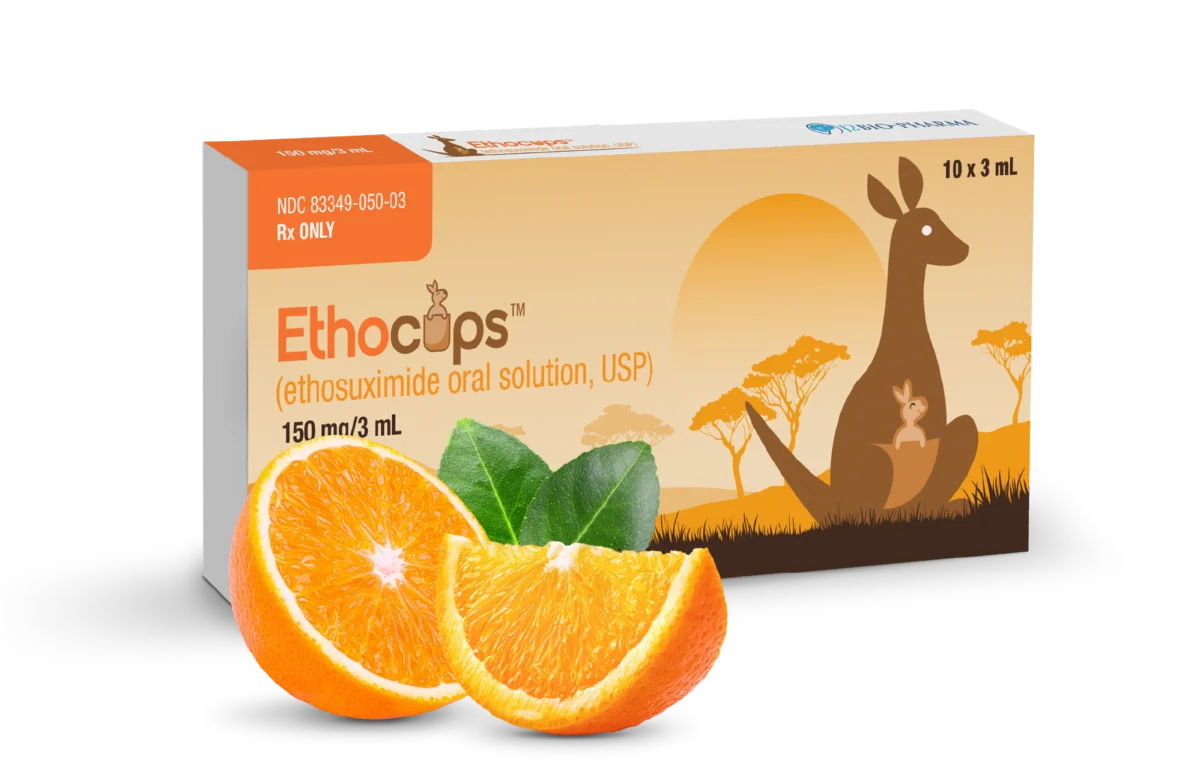
ETHOCUPS is available in 3 doses: 150 mg/3 mL, 250 mg/5 mL, 500 mg/10 mL
| Initial Dose | ETHOCUPS Daily Dose | Number/Size of ETHOCUPS per Day |
|---|---|---|
|
3 to 6 years of age |
250 mg |
One 5 mL cup |
|
6 years of age and older |
500 mg |
One 10 mL cup or Two 5 mL cup |
Directions for ETHOCUPS
Following the initial dose amount prescribed, the amount will gradually increase based on response to treatment.
It's important to take ETHOCUPS exactly as directed by your prescribing doctor. Don't stop taking ETHOCUPS suddenly, change the amount you take, or change other medications without first talking with your doctor.
ETHOCUPS is designed for convenience, so it can easily be taken with any daily routine.

At home

In school

While traveling

Patients with commercial insurance coverage pay as little as $0
Patients without commercial insurance pay no more than $15

Specialty pharmacy support
Dedicated support staff to help with insurance and refills, plus free home delivery

Manufactured in the USA
Consistent, high-quality product without shipment delays
IMPORTANT SAFETY INFORMATION
WARNING: RISK OF SUICIDAL THOUGHTS AND BEHAVIORS; BLOOD DYSCRASIAS; DRESS AND SERIOUS DERMATOLOGIC REACTIONS; ABRUPT WITHDRAWAL; HEPATIC AND RENAL EFFECTS; AND USE IN PREGNANCY AND LACTATION
Suicidal Thoughts and Behaviors
Antiepileptic drugs (AEDs), including Ethocups™ (ethosuximide oral solution), increase the risk of suicidal thoughts or behavior in patients. Patients should be monitored for the emergence or worsening of depression, suicidal, ideation, or any unusual changes in mood or behavior. Patients, their caregivers, and families should be informed that AEDs increase the risk of suicidal thoughts. Advise patients, caregivers, and families to be alert to these symptoms and report them immediately.
Blood Dyscrasias
Ethosuximide has been associated with serious hematologic abnormalities, including leukopenia, agranulocytosis, pancytopenia (with or without bone marrow suppression), eosinophilia, and thrombocytopenia. Periodic CBCs are recommended. Discontinue if significant hematologic changes are observed.
Drug Reaction with Eosinophilia and Systemic Symptoms (DRESS)
DRESS, also known as multi-organ hypersensitivity, has occurred with ethosuximide use and may be fatal or life-threatening. Clinical presentations may include fever, rash, lymphadenopathy, facial swelling, hepatitis, nephritis, myocarditis, or hematologic abnormalities. Eosinophilia is often present. This disorder is variable in its expression, and other organ systems not noted here may be involved.
Serious Dermatologic Reactions
Stevens-Johnson syndrome (SJS) and other serious dermatologic events have been reported. Discontinue Ethocups™ at the first sign of rash unless it is clearly unrelated to the drug.
Abrupt Withdrawal
As with other AEDs, abrupt discontinuation may precipitate absence status epilepticus or generalized tonic-clonic seizures. Discontinue Ethocups™ gradually to minimize seizure risk.
Hepatic and Renal Effects
Ethosuximide has been associated with abnormal liver and kidney function tests. Use caution in patients with known hepatic or renal impairment. Periodic urinalysis and liver function testing are advised.
Systemic Lupus Erythematosus
Cases of Systematic Lupus Erythematosus have been reported. Clinicians should be alert to this possibility and monitor accordingly.
Neuropsychiatric Effects
Psychiatric symptoms including aggression, sleep disturbances, depression, and, in rare cases, psychosis or suicidal intent have been reported. Use caution in patients with a history of psychiatric disorders.
Use in Pregnancy
Ethosuximide crosses the placenta. AEDs have been associated with an increased risk of congenital malformations. Causes of birth defects have been reported with ethosuximide. The reports suggesting an elevated incidence of birth defects in children of drug-treated epileptic women cannot be regarded as adequate to prove a definite cause and effect relationship. Anticonvulsant drugs should not be discontinued in patients in whom the drug is administered to prevent major seizures because of the strong possibility of precipitating status epilepticus with attendant hypoxia and threat to life. In individual cases where the severity and frequency of the seizure disorder are such that the removal of medication does not pose a serious threat to the patient, discontinuation of the drug may be considered prior to and during pregnancy, although it cannot be said with any confidence that even minor seizures do not pose some hazard to the developing embryo or fetus. Encourage enrollment in the North American Antiepileptic Drug (NAAED) Pregnancy Registry (1-888-233-2334).
Use in Lactation
Ethosuximide is excreted in human milk. The effects on nursing infants are unknown. Use caution when administering to breastfeeding women.
Pediatric Use: Safety and effectiveness in pediatric patients below the age of 3 years have not been established.
Contraindications
Ethocups™ is contraindicated in patients with hypersensitivity to ethosuximide or other succinimides. Ethosuximide, when used alone in mixed types of epilepsy, may increase the frequency of grand mal seizures in some patients. Ethosuximide may impair the mental and/or physical abilities required for the performance of potentially hazardous tasks, such as driving a motor vehicle or other such activity requiring alertness; therefore, the patient should be cautioned accordingly.
Drug Interactions
Ethosuximide may interact with AEDs. Monitor serum levels if used in combination with agents like phenytoin or valproic acid, which may alter ethosuximide plasma concentrations.
Adverse Reactions
Ethosuximide may interact with other AEDs. Monitor serum level if used in combination with agents like phenytoin or valproic acid, which may alter ethosuximide plasma concentrations.
Overdosage
Acute overdose may lead to nausea, vomiting, CNS depression, and coma with respiratory depression. There is no known antidote. Treatment includes gastric lavage, activated charcoal, and supportive measures. Hemodialysis may be effective.
Please see full Prescribing Information, including Medication Guide, for complete safety and dosing information.

ETHOCUPS is a trademark of J2Bio-Pharma, LLC.
© 2026 All rights reserved. 2025ETH-WS-01
This site contains information intended for US healthcare professionals.
By continuing, you confirm you are a US healthcare professional.